
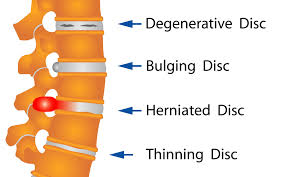
Intervertebral discs are located between each vertebrae bone in your spine. The discs have three main functions, as “shock absorbers” when you walk around, to let the spine move and flex, and to separate the bones of the spine so they do not rub painfully against each other.
A herniated disc is not always a sudden catastrophe. Sometimes it builds in silence. Quietly. Gradually. Day after day, small strain patterns stack up. A little bending here. Long hours sitting there. Poor posture. Repetitive lifting. Weak spinal support. Age. Old injuries. The disc keeps absorbing stress until one day it stops adapting well and starts protesting.
When that happens, the pain can feel deceptively unpredictable. It may stay in the low back. It may travel into the leg. It may strike the neck and then shoot into the shoulder or arm. For some, the pain strikes sharp and sudden, almost like a knife. Others report a completely different sensation. A slow burn. A restless tingling. A strange buzzing beneath the skin. Sometimes it feels heavy. Sometimes parts of the body go numb. Weakness can creep in without warning. And in certain situations, the smallest movement can trigger a flare. Standing up. Taking a few steps across the room. A cough. A sneeze. Even the simple act of turning over in bed can suddenly set the nerves off.
That is what makes this condition so frustrating. The pain is not always local. It is not always logical. It does not always stay in one place. A patient may complain about leg pain and assume the leg is the problem when the real source is buried in the spine. Another may feel arm numbness without much neck discomfort at all. A disc problem can be sneaky like that. It can disguise itself. It can mislead. It can send the body mixed signals that are easy to misunderstand if the evaluation is too shallow or too rushed.
Degenerative disc disease can therefore lead to a number of painful conditions, including:
These painful conditions can occur from repetitive stress or strain, poor posture for a prolonged period, trauma, such as from an accident, or aging.
We do not believe in guesswork. We believe in sorting out the whole picture. That matters because a painful disc is rarely just a painful disc. There may also be inflammation. Nerve irritation. Mechanical compression. Segmental instability. Degeneration. Reduced circulation. Loss of proper motion. A layered problem needs a layered understanding.
When treatment skips over that complexity, people often get stuck in a loop. One option dulls the pain for a while. Another calms symptoms, then they come roaring back. Another approach may be too generic. Another may be too aggressive. And too often, the patient is left wondering why nothing truly changed.
That is why we focus on identifying what is actually happening and why it is happening. We review symptoms carefully. We correlate them with the clinical exam. We study the imaging. We look at how the disc and surrounding structures may be affecting function. Then we determine whether the patient may qualify for non-surgical herniated disc treatment Bolingbrook, IL patients can pursue before resigning themselves to more invasive measures.
That distinction matters. A lot. Not every herniated disc is a surgical case. Not every severe symptom means surgery is inevitable. Not every failed treatment means the road ends there. Sometimes the missing piece is not more force. It is better precision.
When the blood supply is interrupted, your body fights back, causing inflammation at the nerve root. This can cause a range of symptoms, depending on the site of the inflammation.
Common pain symptoms include:
Some or all of these symptoms may be present. For example, a patient may present with arm pain but suffer no symptoms in the back or neck. Each herniated disc case is unique which is why the specialist at our Bolingbrook non-surgical disc and laser center takes the time to thoroughly investigate your individual case.
Other serious pain symptoms that may occur, can include:
Of these, if you experience incontinence, issues with urinating or bowel movements, or numbness in your genital area, it is important that you contact a medical professional immediately as these are signs of a serious condition.
To diagnose a herniated disc, you will need a physical examination that takes into account your detailed medical history. You will also need a comprehensive neurological or orthopedic exam that looks at your pain symptoms.
X-rays or MRIs are used to identify the site of the pain and treatment options will vary based on your circumstances. A New, Cutting Edge Technology Driven Treatment Approach Treats the Root Cause of the Diseased or Pathological Disc
At the ProMED Pain Rehabilitation Institute, we offer an alternative to drugs or surgery. When chiropractic, physical therapy, injections, surgery, or pain killers have been unable to help, our Non-Surgical Spine Center is here.
ProMED Pain Rehabilitation Institute provides an alternative to these “hit and miss” back pain treatments. We offer a non-surgical, comprehensive approach to disc pain all under one roof. Our treatment is a safe, clinically proven alternative to drugs and surgery
There is no down time, no pain during the process, and no side effects. Contact our Non-Surgical Spine Center today at 630-226-5754 to see if you qualify for care
The best doctor to see is one who takes the condition seriously enough to investigate it fully. That means looking beyond surface pain, reviewing imaging, understanding neurological symptoms, and considering how the disc is affecting real function. We believe patients deserve a provider who understands spinal disc conditions in depth and does not treat surgery like the automatic next step.
L4 and L5 issues can improve significantly, sometimes dramatically, but the answer depends on more than the disc alone. Severity matters. Chronicity matters. Movement patterns matter. Disc health matters. If the root problem is addressed well and the patient responds favorably, long-term relief is possible. Still, no honest answer should pretend every case follows the same script.
Some herniated discs improve to the point that symptoms fade almost entirely. Some patients return to daily life with little to no disruption. But a guaranteed 100 percent healing outcome is not something we would promise. Healing depends on the degree of injury, the condition of the disc, nerve involvement, inflammation, biomechanics, and the body’s response to care.
It varies wildly. For one person, it may hover at a dull and tolerable three. For another, it may erupt into a nine or ten with searing, radiating, electric pain that derails walking, sleeping, working, and concentration. Pain severity is personal, but functional loss often tells the bigger story.
The progression is often described in five general phases: degeneration, prolapse, protrusion, extrusion, and sequestration. That framework helps explain how a disc can go from wear and weakening to a more advanced structural failure. Not every patient moves through those phases in a perfectly clean order, but the model is useful for understanding progression.
A chiropractor may help certain patients, especially when care is guided by a careful diagnosis and integrated into a broader strategy. Still, no single tool works for everyone. The real issue is whether the treatment approach matches the condition, respects the level of disc injury, and addresses the structures actually driving the pain.

Specializing in a new, cutting edge non-surgical spinal disc treatment

The cost is significantly less than surgery

Get FDA cleared, state of the art treatment

We tailor your treatment based on your health history

We’ll address your specific conditions & individual needs
If disc pain has been grinding down your sleep, your focus, your mobility, and your confidence, we want you to know this plainly. You may still have options. Real ones. At ProMED Pain Rehabilitation Institute, we believe patients deserve more than temporary patches and rushed conclusions. We believe they deserve a serious evaluation, a clear explanation, and a genuine opportunity to move toward relief without being pushed straight into invasive care.
If you have been searching for Degenerative disc disease treatment Bolingbrook, IL or looking for advanced herniated disc treatment Bolingbrook, IL, now is the time to take the next step. Contact us today, schedule your screening, and let us help you find out whether you qualify for care.